Imagine investing in SEO for 8 months, watching your traffic grow every month, yet your revenue barely changes. It's one of the most aggravating issues that everyone faces today. The issue is rarely that SEO isn't generating results, it's simply that the wrong keywords are attracting the wrong audience, visitors aren't following a conversion path and the way AI search experiences work is shifting how people find businesses. In 2026, the companies that optimize for business outcomes will get better at improving their SEO ROI.
This guide reveals the truth behind what really has an impact on SEO ROI in today’s environment. You'll discover how keyword intent mapping, GEO integration and a structured SEO funnel are all connected, and how to build sustainable business growth by increasing qualified traffic, improving conversions.
Without a clear understanding of how to measure SEO ROI it can be difficult to fully see the ROI of your SEO and many businesses fail to create results that they can see. Many companies measure the return of investment (ROI) for their SEO campaigns by calculating the profit that the company has made after the marketing campaign minus the expenditure incurred on the campaign. This is a very simplistic overview, but in most instances, it doesn't capture the full story because most customers will likely come in through organic traffic well before converting.
Example: If your business invests ₹4,00,000 in SEO and generates ₹12,00,000 in revenue, the ROI is 200%.
This formula, however, can be misleading when analytics do not give credit for all interactions, but only the last one. A customer can find your business in an informational blog, then search for you again in the future using a branded query and then compare your competitors, and then look you up and click a remarketing email to convert. Organic search helped to drive the sale, but last-click may not accurately measure its value.
Organic Revenue Growth
These leads are actually qualified leads that have been acquired through organic search.
Customer Acquisition Cost (CAC)
Lead-to-sale conversion rate
Organic conversion value
It is also important to have realistic expectations as a business. There is a lag of anywhere from 6 to 18 months in most competitive industries before SEO starts to bring some solid monetary results. The first couple of months are typically spent on site improvements, content, authority and search engine trust, and once you reach that point, revenue should start to increase. After you have determined your SEO ROI, you will need to know what's contributing to that number. Track these 5 important SEO metrics for each quarter to find out what works, what isn't and what can be improved before changing your strategy.

We map keyword intent, integrate GEO best practices, and build SEO funnels engineered for qualified traffic and measurable business outcomes.
One of the most effective ways of enhancing the SEO ROI is to match your content with the intent of the searcher. Good SEO strategies aren't just about keywords that people are searching for, they are about what they are searching for.
Ask yourself:
This is called keyword intent mapping, pairing keywords with different customers' journey stages so that customers will naturally fall into lead or customer.
| Intent | User Goal | Example Keywords | Best Content Format |
|---|---|---|---|
| Informational | Learn about a topic | "What is local SEO", "SEO ROI calculation" | Blogs, guides, tutorials |
| Navigational | Find a specific brand or page | "Brand Make SEO", "Brand Make contact" | Homepage, service pages, contact page |
| Commercial Investigation | Compare options before choosing | "Best SEO agency", "SEO pricing comparison" | Comparison articles, case studies, reviews |
| Transactional | Take action or make an enquiry | "Hire SEO agency", "SEO services near me" | Service pages, landing pages, quote forms |
Suppose a digital marketing agency markets just the term "SEO services”. It is competitive but it is not engaging users in their decision making process. Rather, an intent-based content strategy might take the form of this:
| Customer Stage | Search Query | Content |
|---|---|---|
| Awareness | "What is SEO ROI?" | Educational blog |
| Consideration | "Best SEO agency for local business" | Comparison guide with case studies |
| Decision | "SEO agency in Pune" | Service page with testimonials pricing discussion |
| Action | "Contact SEO agency" | Contact page with consultation form |
Making content for each step ensures that visitors can follow the process, which means they're likely to convert.
Studies have shown and shown, that users searching for the purpose of transactions or commerce are much more ikely to convert than users searching for general information. Meanwhile, the information creates trust and draws traffic that can convert into customers. All of these intent-driven pages, combined, build an SEO funnel that helps build more qualified traffic, better engagement and better organic revenue over time.
Don't try to produce content for individual keywords, instead, develop your website based on the customer's journey:
It allows search engines to better understand your site's topical relevance, and helps visitors easily navigate the site and find the information they're looking for, and then move their way naturally toward conversion.
The other benefit is that it helps to alleviate keyword cannibalization. If two or more pages rank for the same keyword, the sharing of ranking power will make it more difficult for any page to be successful But it can be avoided by intent mapping, which assigns a specific purpose to every page. A major reason why many SEO campaigns don't get off the ground is because they are optimized for keywords and not for customer intent. Make sure to identify errors in mapping that will impact ROI.
Check your current keywords, categorize them according to search intent, and optimize pages that don't align with user intent. This means that businesses can get better SEO results in the long run, as every piece of content will be having a tangible ROI on the business.
When sites don't move in their rankings, many businesses are still seeing organic traffic drop and it's difficult to see why the returns from SEO have changed. With the rise of AI-driven search engines, traditional SEO strategies might no longer yield the same results as they once did as they now generate content that directly answers the user's query. GEO integration is a crucial element of an up-to-date SEO approach. GEO integration enhances content accessibility for generative search systems, not just by rankings, but by improving its understandability, summarization, and reference. This means that the content is broken down into well-defined sections, the answer is provided in a concise manner, there are professional perspectives, schema markup, and topical authority. When combined, these factors enhance the likelihood of being seen in AI responses, ensuring businesses stay visible, connect with the right audience, and maintain optimal SEO ROI in the face of evolving search trends. These strategies will be discussed in greater detail by a dedicated guide.
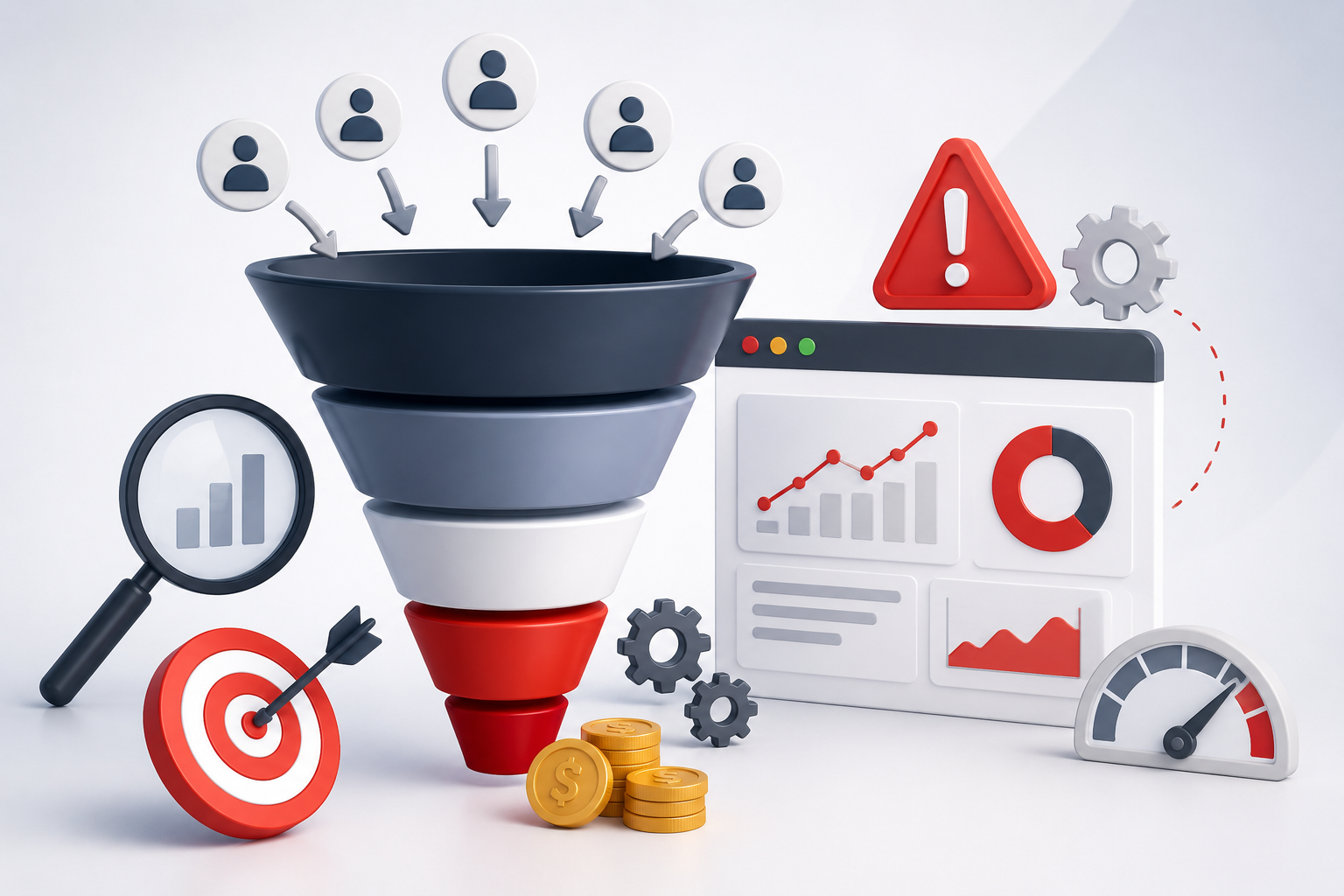
Creating traffic is just the first of many steps. If they are not in an effective SEO funnel, then a mere fraction of visitors will turn into paying customers..
Users are looking for solutions and problem information.
Users are researching and comparing providers or options.
Users are ready to ask questions or make a purchase.
Common issues include:
Each of these gaps directly impacts conversions and revenue. Optimizing every stage of your SEO funnel helps turn more visitors into qualified leads and paying customers.
Combining these elements is significantly more effective than each applied separately. Keyword intent mapping outlines user needs and motivations across their journey. With GEO integration, content is visible both via traditional and AI-powered search. The SEO funnel then takes them to enquiry without any extra hurdles.
Together, companies cease to view SEO as a ranking game and start to see it as a revenue generation system. Each page serves a need, each visitor comes from a path and each optimization brings better ROI in the long run for SEO.
Some of the following misconceptions continue to be a hindrance to making a positive impact for businesses.
SEO takes a long-term strategy. Sustainable growth will take weeks to months, not months
Improving a site's ranking on irrelevant keywords is of no benefit in terms of business results. Revenue is dependent on the number of visitors who are qualified. .
The way people search, algorithms, competition, and the AI experiences are constantly evolving. Up to date news updates continue to be vital.
What's more important is the quality and the profitability of your leads than the whole website traffic
If you want your content to be effective, it should address consumer needs mainly with a well planned SEO strategy In time, businesses that steer clear of these misconceptions establish a better and more predictable ROI from their SEO efforts.
In 2026, SEO ROI isn’t measured by traffic alone, it’s measured by attracting the right visitors who are more likely to convert. Organic businessess know what people are searching for, anticipate the discovery by AI and support it via GEO integration while funneling visitors through a well-defined SEO funnel. These strategies combine for a scalable approach that provides visibility and conversions.
If you're wanting to develop an SEO strategy centered on measurable business outcomes instead of vanity metrics? look into the services of Brand Make, contact us to speak to a person about a strategy made for your business goals.