How Many Main Pillars of Digital Marketing Are There?
(Complete 2026 Guide)

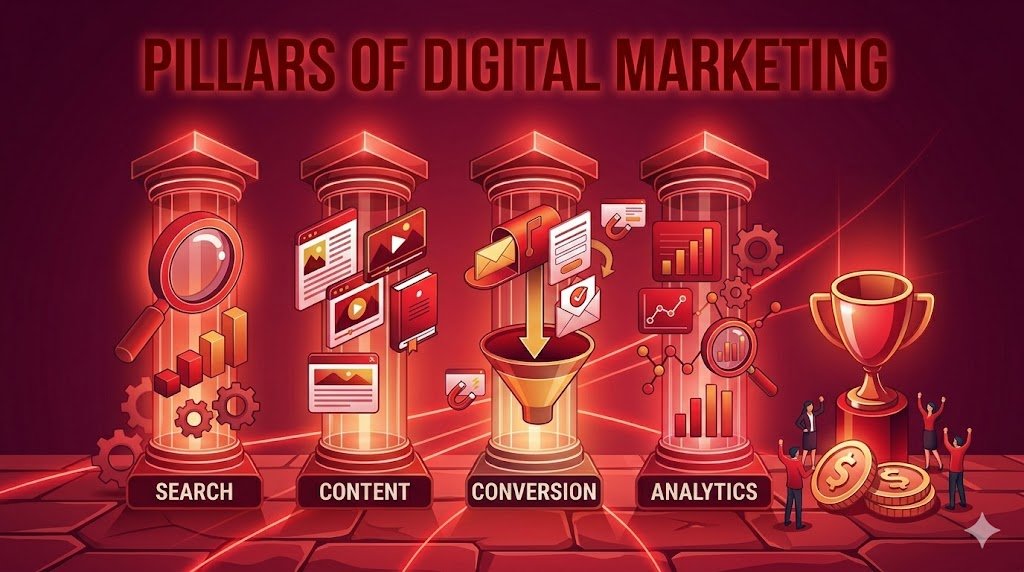
7 pillars of digital marketing explained

Why "Pillars" Matter in Digital Marketing

Without clearly defined pillars, even the best campaigns crumble budgets, bleed, messaging drifts, and results become impossible to replicate. That's why Peoples keep asking: how many main pillars of digital marketing are there?

A "pillar" is a core strategic discipline that, combined with others, creates a complete, self-reinforcing system, each one load-bearing. Remove one, and the structure wobbles.

In 2026's competitive landscape, clarity on the pillars is the difference between predictable growth and chasing trends without direction, whether you're a solo founder or working with a digital marketing agency in Pune.

“Strategy without structure is just a good intention.” Understanding the pillars moves you from wishful thinking to a repeatable system that drives ROI.

Are There 4, 6, 7 or 12 Pillars? Comparing Models

Ask ten marketers how many pillars exist, and you'll get ten answers reflecting how the field has matured over time.

Model Key Focus Best For
4-Pillar Model SEO, SEM, Social Media, Content Beginners and micro-businesses
6-Pillar Model Adds Email & Analytics Growing SMEs
7-Pillar Model Adds CRO to the mix Most businesses in 2026
12-Pillar Model Influencer, Mobile, Automation, UX, etc. Enterprise-level brands

The 4-pillar model leaves gaps around measurement and conversion. The 12-pillar model can overwhelm small teams. The 7-pillar model hits the sweet spot — comprehensive enough to cover the full customer journey, focused enough to stay actionable for most businesses.

Google, HubSpot, and industry practitioners consistently align around these seven disciplines as the core of any serious digital strategy in 2026.

The 7 Main Pillars of Digital Marketing Explained

Click each pillar to explore its role in a modern digital strategy.

1. SEO (Search Engine Optimization) +

SEO is the backbone of digital visibility. Ranking on page one isn't luck; it's technical excellence, quality content, and authoritative backlinks working together. In 2026, Google's SGE, Core Web Vitals , and E-E-A-T drive rankings. A strong SEO strategy prioritises user intent over search engines, and unlike paid ads, organic traffic compounds long after the initial investment.

2. Content Marketing +

Content powers every other pillar. Without it, SEO has nothing to rank, social has nothing to share, and email has nothing to say. The goal isn't volume, it's content that answers real questions, solves genuine problems, and builds trust.

3. Social Media Marketing +

Social media is where your brand's personality lives, the front porch people see before deciding to knock. In 2026, channel selection is critical. A B2B brand may thrive on LinkedIn while ignoring Instagram; a lifestyle brand might dominate Reels while skipping Twitter (X). The smartest social media strategies go where the audience is, not where the algorithm is loudest. Consistency, community engagement, and authentic storytelling drive real results; follower counts mean nothing without genuine engagement.

4. Paid Advertising (SEM/PPC) +

If SEO is the slow burn, paid advertising is the lighter fluid. Google Ads, Meta Ads, LinkedIn Ads, and programmatic platforms offer precision targeting by job title, browsing history, income bracket, or keyword at speed. The catch: budgets evaporate quickly without smart campaign architecture, negative keyword lists, and regular A/B testing to separate profitable PPC from expensive noise.

5. Email Marketing +

Email is the most underrated pillar consistently delivering among the highest ROI of any channel, often cited at around $36 per $1 spent. Your email list belongs to you unlike social algorithms or ad costs, it only grows in value. In 2026, personalization and segmentation are key: generic blasts tank open rates, while sending the right message to the right segment is where the real ROI lives.

6. Analytics & Data Tracking +

You can't manage what you don't measure. GA4, Search Console, Meta Business Suite, and heatmapping tools like Hotjar aren't optional; they're the instruments on your dashboard. Good analytics tracks what matters: conversion rate, customer acquisition cost, lifetime value, and channel attribution. Vanity metrics make mediocre campaigns look successful. Real analytics reveals what's working, what's wasting budget, and where to double down.

7. Conversion Rate Optimization +

CRO is the most overlooked pillar and possibly the highest-leverage activity available. Improving your site's conversion rate from 1% to 2% doubles revenue without spending an extra rupee on traffic. CRO involves A/B testing landing pages, refining CTAs, improving load speed, simplifying checkout, and removing friction at every step of the user journey. It's part science, part psychology and the results compound powerfully when combined with strong SEO and paid traffic.

How the Pillars Work Together

The real magic is integration. SEO brings in a visitor who discovers a content piece. That content earns a newsletter subscription. A targeted email sequence nudges them to a CRO-optimised product page. Retargeting ads recapture those who didn't convert the first time. Analytics tracks every touchpoint, revealing what to scale and what to fix.

This is integrated digital marketing, not seven siloed campaigns, but seven disciplines amplifying each other. A spike in organic traffic from an SEO win grows the email funnel. A CRO improvement stretches paid ad spend further. The brands winning in 2026 don't have the biggest budgets; they have the most coherent systems.

Integrated Digital Marketing

Which Pillar Should You Focus on First?

It depends on your timeline and budget.

If you need results within 30–90 days:

Start with paid advertising for immediate, measurable traffic and pair it with basic analytics so you're not spending blind.

If you're playing a longer game (6–18 months):

Prioritise SEO and content marketing together; the upfront investment pays dividends for years. Build your email list from day one; it gets more valuable with every subscriber.

No matter where you start, install analytics first. Before writing a single blog post or running your first ad, knowing your baseline is what makes everything measurable.

For small businesses, trying to master all seven pillars simultaneously leads to burnout and mediocre results. Pick two or three aligned with your immediate goals, execute them well, then layer in the rest as capacity grows.

Common Mistakes When Building on These Pillars

Treating pillars as independent silos. Each pillar should feed the others' blog content, which fuels email campaigns, and social posts drive traffic to SEO-optimized pages. Running them as disconnected efforts is the most common mistake.

Skipping analytics until "things are more established." By the time you set up proper tracking, months of data are lost. Set up GA4 and conversion tracking before your first campaign goes live.

Neglecting CRO while obsessing over traffic. If your landing page converts at 0.5%, more traffic won't fix a broken funnel. Always audit conversion bottlenecks before scaling spend.

Chasing every new channel. Instagram, X, the next big platform, new channels can be powerful, but only after your core pillars are solid. Master the fundamentals first.

Inconsistency in content and email. Two blog posts in January and silence until June doesn't build authority. Consistent, modest frequency outperforms sporadic bursts every single time.

Frequently Asked Questions

Why do some sources list 6 or 12 pillars of digital marketing? +
Different frameworks reflect different needs. A 6-pillar model omits CRO, treating conversion as part of the general strategy. A 12-pillar model adds influencer marketing, mobile, affiliate, and automation legitimate disciplines, but is better suited to enterprise brands with larger teams. The 7-pillar model covers the full customer journey comprehensively without overwhelming small or medium-sized businesses.
Do I need all seven pillars for my business? +
Not immediately, and perhaps not all at the same depth. A local service business might prioritise SEO, Google Ads, and analytics over an elaborate content programme. A SaaS startup might lean on content, email, and CRO before investing in paid social.
How long does it take to see results from digital marketing? +
It depends on the channel. Paid advertising can generate traffic within hours. SEO and content marketing typically take 3–6 months to show meaningful traction, and 12+ months to compound significantly. Email and CRO improvements can show results within weeks.
How much should a small business budget for digital marketing? +
A common benchmark is 5–10% of revenue, but what matters more than the total is how it's allocated. Early-stage businesses should prioritise analytics setup (low cost, high necessity), then SEO and content (lower ongoing spend, higher long-term return), before scaling into paid channels.
Is social media marketing necessary if I'm already doing SEO and paid ads? +
Not strictly necessary for every business, but it serves a distinct role: trust-building and brand familiarity. Users who see your brand on social before clicking a search result or ad convert at higher rates because familiarity reduces friction.